How Gaj-Dastak Is Transforming Human–Elephant Conflict in
A Fragile Balance Between Man and Elephant
In the forests and farmlands of Chhattisgarh, a delicate tension exists between two giants of survival — the human and the elephant.
As development expands and forests shrink, human–elephant conflict (HEC) has become one of India’s most pressing conservation challenges.
Every year, elephants stray into villages searching for food or safe passage, while frightened communities respond with panic, noise, and sometimes violence.
In this struggle for space and safety, Gaj Dastak stands as a beacon of hope — a research-driven, humane project aiming not to fight elephants, but to listen, understand, and coexist.
The Rising Challenge of Human–Elephant Conflict in Chhattisgarh
Chhattisgarh’s forests form a critical corridor for elephant movement across eastern and central India.
However, rapid mining, agriculture, and infrastructure projects have fragmented these ancient routes.
According to state wildlife records, elephant encounters have risen sharply in the last decade — leading to economic losses, property damage, and human and elephant fatalities.
Yet, labeling elephants as aggressors misses the truth: these intelligent animals are simply reacting to human encroachment. Their search for food, water, and safety drives them into spaces that were once their own.
Understanding the Elephant Mind
Elephants are remarkably emotional and intelligent creatures. They remember migration paths, recognize individuals, and mourn their dead.
When elephants enter human spaces, it’s rarely aggression — it’s confusion and hunger.
Through elephant behaviour research in India, scientists have learned that elephants respond predictably to environmental cues like sound, smell, and light.
This understanding forms the foundation of Gaj Dastak’s approach — addressing the conflict by respecting elephant psychology.
The Science of Coexistence
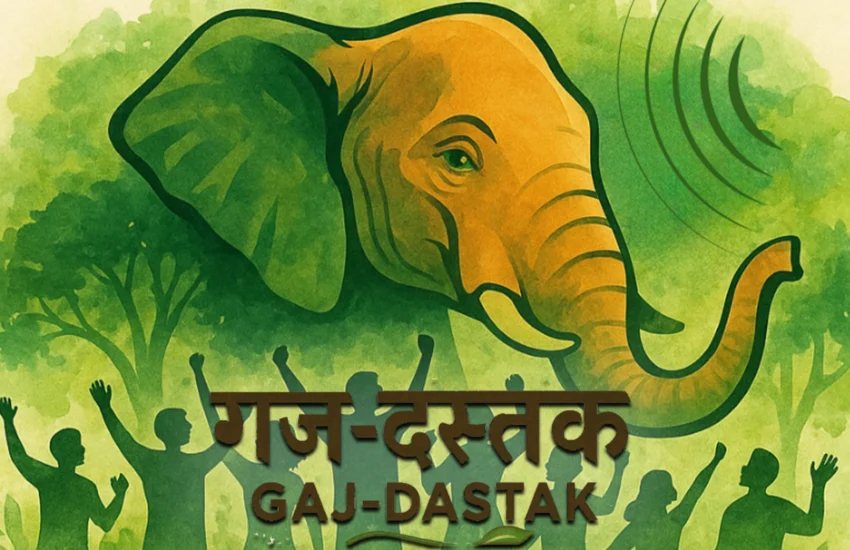
Gaj Dastak was born out of a simple yet powerful idea — that technology can be used not to harm elephants, but to communicate with them.
Unlike traditional deterrents (electric fences, firecrackers, or chili fences), Gaj-Dastak uses a humane acoustic deterrent system designed from deep scientific insights into elephant behavior.
The project’s research team analyzed global and national case studies, combining bioacoustics, behavioural ecology, and community feedback to design sound patterns that safely redirect elephants without causing distress. This innovative approach addresses the pressing issue of Human–Elephant Conflict by fostering coexistence between communities and these majestic creatures. By integrating scientific insights with local perspectives, the project not only prioritizes the well-being of elephants but also empowers communities to mitigate potential conflicts. The resulting sound patterns serve as a harmonious solution, demonstrating the importance of collaboration in wildlife conservation efforts. As we explore the intricacies of animal behavior, we unveil new pathways for coexistence and respect for the natural world. ecology, and community feedback to design sound patterns that safely redirect elephants without causing distress.
This non-invasive, cost-effective, and scalable technology helps avoid direct confrontation — protecting crops, homes, and lives.
A Model Rooted in Community and Conservation
At the heart of Gaj Dastak’s success is local participation. Villagers are trained to operate alert systems, report elephant movement, and maintain sensors.
Involving communities not only builds trust but ensures long-term sustainability.
The project also collaborates with forest departments and conservation agencies, aligning its model with Indian Elephant Conservation policies and wildlife corridor management goals.
Impact and Early Success
Pilot projects under Gaj Dastak have reported reduction in conflict incidents in affected villages.
Beyond numbers, the project’s true impact lies in the shift in mindset — people now see elephants not as invaders, but as co-inhabitants.
Farmers who once feared nightly raids now use technology to coexist. Children learn about elephants as part of their ecosystem, not enemies to be driven away.
A Call for Compassion and Collaboration
Human–elephant conflict is not a local issue — it’s a global warning about the fragile boundary between humans and nature.
By merging technology, empathy, and science, Gaj Dastak shows that peaceful coexistence is achievable.
If other states replicate this model, India could set a global precedent for ethical conservation and human-wildlife harmony.
Conclusion: A Future Where Every Footstep Matters
The sound of Gaj Dastak is more than a deterrent — it’s a call to conscience.
In every hum of its acoustic system echoes a promise: that progress doesn’t have to come at the cost of compassion.
Through innovation, research, and unity, Chhattisgarh is showing the world how to coexist with its gentle giants — one sound wave at a time.
