How Thermal Imaging Detects Elephants — Even in Total Darkness
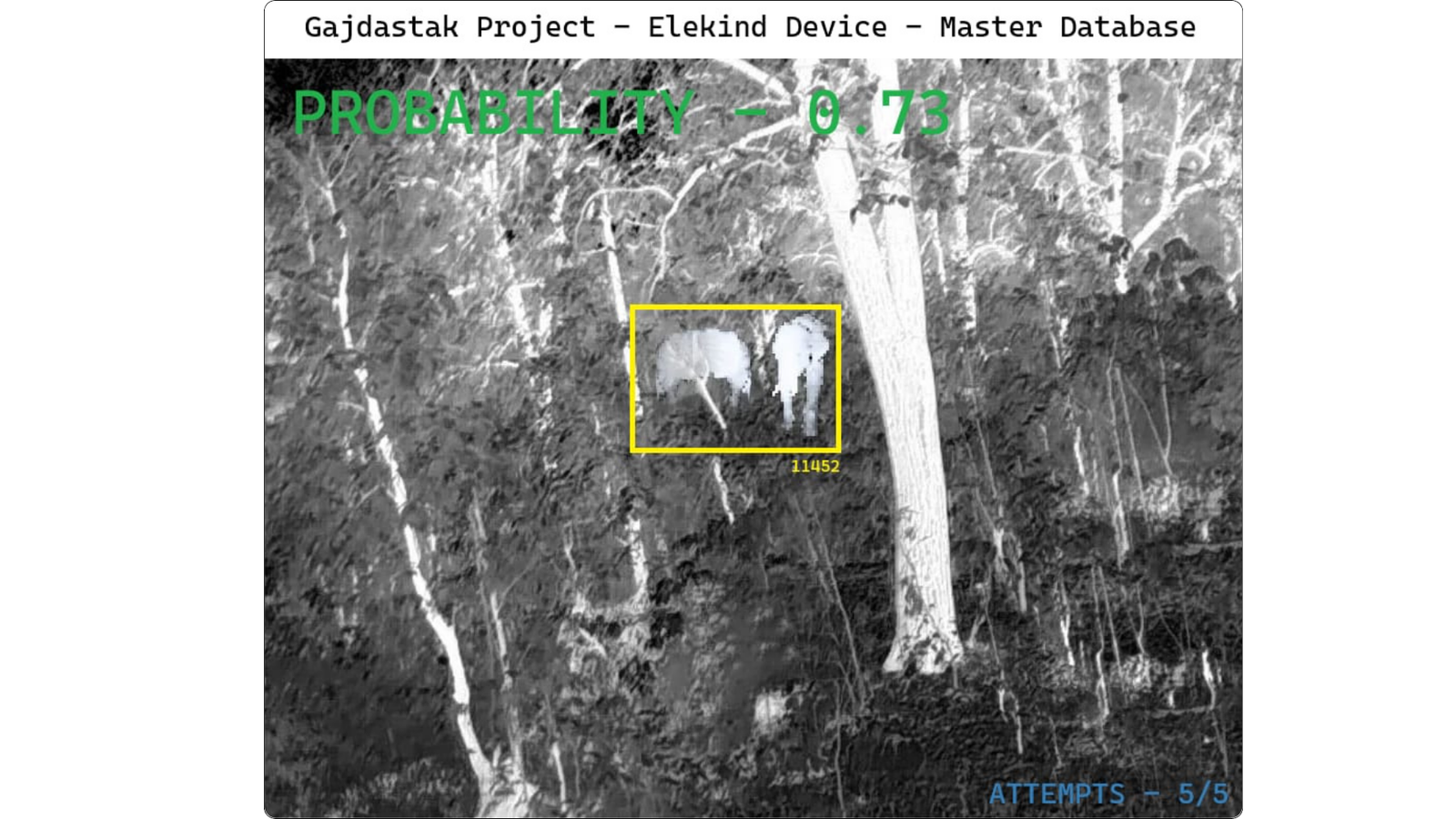
Actual thermal detection output from GAJ-DASTAK — elephant identified by AI with probability score in complete darkness
The deadliest hours for human-elephant conflict are the hours humans can see least. Elephants move primarily at night, navigating through forests and across agricultural land in conditions of zero visibility. Fog, dust, moonless nights, dense canopy cover — these are the conditions where conflict occurs and where traditional surveillance fails completely. Thermal imaging changes this equation. A thermal camera does not need light. It sees heat. And an elephant, with its massive warm body moving through a cooler landscape, is one of the strongest thermal signatures in any forest scene.
What Is Thermal Imaging?
Every object with a temperature above absolute zero (-273.15°C) emits infrared radiation. The warmer the object, the more intense the radiation. Thermal imaging cameras contain specialized sensors that detect this infrared radiation and convert it into a visible image where brightness corresponds to temperature.
The infrared band most useful for wildlife detection is Long-Wave Infrared (LWIR). This band is optimal for several reasons: it corresponds to the peak thermal emission of objects at biological temperatures, it passes through atmospheric moisture and light fog more effectively than shorter infrared bands, and it is not affected by solar reflection (unlike Near-Infrared or Short-Wave Infrared).
In simple terms: a thermal camera in the LWIR band creates an image purely from the heat emitted by objects in its field of view. No light source is required. No illumination. No flash. The image exists because the scene has temperature variation, and temperature variation is always present in natural environments.
Why Elephants Have Strong Thermal Signatures
Asian elephants are ideal subjects for thermal detection. Their core body temperature is approximately 35.5–36.5°C. While their thick skin (up to 2.5 cm) provides some insulation, the sheer surface area of an adult elephant (approximately 30–40 square meters) means enormous total heat emission. Key thermal emission points include the ears (which elephants use as radiators, with blood vessels close to the skin surface), the trunk, and the temporal region of the head.
At night, when ambient temperatures in tropical forests typically drop to 15–25°C, the temperature differential between an elephant and its surroundings can be 10–20°C. This creates a stark, unmistakable thermal contrast. On a thermal image, an elephant appears as a large, bright, clearly delineated warm mass against a cooler background — even through foliage, dust, and light rain.
Thermal Detection: Conditions Comparison
Visible-Light Cameras: Why They Fall Short at Night
Standard visible-light cameras — including those with infrared (IR) LED illumination — face fundamental limitations for wildlife detection. IR-illuminated cameras (commonly sold as "night vision" CCTV) project near-infrared light and capture the reflection. This works at short range but falls off rapidly with distance. The illumination also alerts animals and can cause eye-shine artifacts that confuse detection algorithms.
More critically, visible-light cameras are largely blind in fog. Water droplets scatter visible and near-IR light, creating a white-out effect. In tropical forest-edge environments, morning and evening fog is common during the cooler months — precisely the hours when elephant movement peaks. A camera system that loses detection capability during peak risk hours is not a viable conservation tool.
Thermal imaging is largely unaffected by fog at the ranges relevant to elephant detection because LWIR radiation is far less scattered by water droplets than visible light. The thermal signature of an elephant passes through moderate fog with sufficient intensity for detection and classification.
Challenges of Thermal Imaging in the Field
While thermal imaging provides clear advantages over visible-light approaches, deploying thermal cameras in tropical field environments introduces real engineering challenges that any wildlife detection system must address.
Sensor drift is one such challenge. All thermal sensors experience some degree of drift as the sensor's own temperature changes due to ambient temperature shifts, self-heating, or day-night cycles. This can cause gradual brightness and contrast changes in the output image. Without proper mitigation, this drift can degrade AI model performance over time.
Environmental variability is another factor. Tropical deployment environments experience extreme temperature swings across seasons, high humidity during monsoon, and dust during the dry season. Any thermal detection system must be engineered to maintain accuracy across these varying conditions.
Partial occlusion in forested environments means that elephants are frequently behind or among trees. Thermal signatures blend with warm vegetation canopy, making detection more difficult than in open terrain. Robust AI models must be trained to handle these partial-view scenarios.
Addressing these challenges requires a combination of hardware design choices, software calibration strategies, and AI training methodologies — areas where significant engineering investment is required to achieve reliable field performance.
How AI Enables Automated Thermal Detection
Raw thermal imagery alone is not enough. The value of thermal imaging for wildlife conservation is unlocked when it is paired with AI that can automatically analyze each frame and determine whether an elephant is present. Modern deep learning models, particularly convolutional neural networks optimized for edge deployment, can process thermal frames in real time on low-power hardware.
The general approach works as follows: a thermal camera continuously captures frames, each frame is passed through an AI model that has been trained to recognize elephant thermal signatures, and the model outputs a confidence score. If the confidence exceeds a defined threshold, the system triggers an alert and response sequence. The entire process happens in milliseconds, enabling continuous real-time monitoring without human involvement.
Training such models effectively requires large volumes of thermal imagery captured from the actual deployment environment and camera hardware. Models trained on generic thermal datasets or imagery from different camera types may not generalize well to specific field conditions. Domain-specific training data is essential for reliable performance.
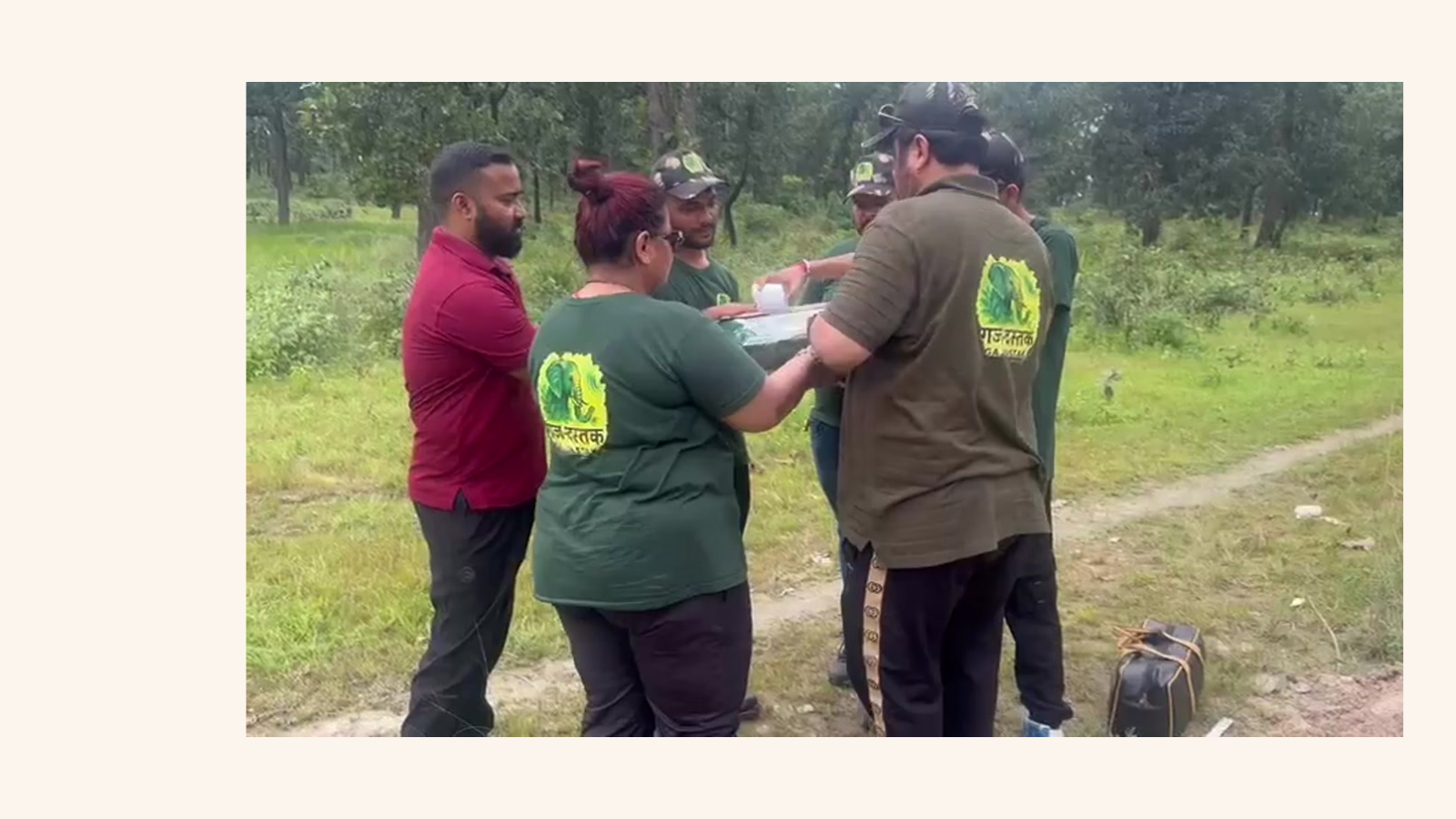
Thermal view showing elephant thermal signature — the bright warm mass is clearly distinguishable from the cooler forest background
From Detection to Action: The Response Chain
Detection alone is not deterrence. The value of thermal imaging in a wildlife protection system is that it provides the early warning that makes effective deterrence possible. When the AI confirms a detection above the confidence threshold, a cascaded response can trigger automatically.
In GAJ-DASTAK's approach, confirmed detections trigger instant SMS alerts to registered forest department personnel, providing situational awareness within seconds. Simultaneously, an acoustic deterrence system activates, playing randomized sounds including honeybee swarm recordings (elephants have a documented aversion to bee sounds, extensively studied by Dr. Lucy King), predator vocalizations, and distress signals. The randomization is deliberate: as discussed in our article on why traditional deterrence fails, predictable stimuli lead to habituation. By varying the stimuli, the system maintains the novelty that sustains deterrence effectiveness.
Detection events are logged for post-deployment analysis and model improvement. Every detection event contributes to a growing dataset that makes future models more accurate — a continuous improvement loop that static deterrence methods cannot achieve.
Field Evidence: Real-World Validation
GAJ-DASTAK's thermal detection system has been deployed and validated across multiple forest divisions in Chhattisgarh, India. These deployments span diverse terrain — from dense Sal forest edges to open agricultural boundaries — and diverse conditions: monsoon season humidity, winter fog, and dry season dust.
Field deployments demonstrated that thermal detection was viable in real forest conditions, with autonomous 24/7 operation validated over extended periods. The strongest field result: zero crop loss during an entire deployment period at one site, earning CAMPA scheme approval and a government validation letter from the Indian Forest Department.
These results were not achieved in laboratory conditions. They were achieved in actual forest environments where elephants move, where fog rolls in at dawn, where temperatures swing from 40°C to 10°C across seasons, and where the nearest power grid may be kilometers away. Thermal imaging — processed by edge AI, deployed on solar power — performed where conventional methods could not.
Conclusion: Seeing What Others Cannot
Thermal imaging is not a novelty technology for wildlife detection — it is the enabling technology. Without the ability to detect elephants in darkness, fog, and dust, no deterrence system can provide the early warning that prevents conflict. Visible-light cameras fail in the exact conditions where detection is most needed. Human patrols are limited by biology. Only thermal imaging provides consistent, all-conditions, all-hours detection capability.
When paired with edge AI and a deterrence system designed to prevent habituation, thermal imaging becomes more than a sensor. It becomes the foundation of a system that can genuinely reduce human-elephant conflict — protecting both the communities and the elephants that share these landscapes.