Why Electric Fences & Firecrackers Fail — The Science of Elephant Intelligence
Every year in India, over 500 human lives and 100 elephant lives are lost to human-elephant conflict. Crops worth hundreds of crores are destroyed. The response, decade after decade, remains the same: electric fences, firecrackers, trenches, and human patrols. Yet the conflict intensifies. The question is not whether these methods are tried hard enough — it is whether they can ever work against an animal as intelligent as the Asian elephant.
The Elephant Brain: Why Deterrence Is Not Simple
The Asian elephant (Elephas maximus) possesses the largest brain of any land animal, weighing approximately 5 kilograms. But size alone does not tell the story. The elephant brain contains roughly 300 billion neurons, with a highly developed hippocampus — the region responsible for spatial memory and long-term recall.
Elephants demonstrate self-awareness (they recognize themselves in mirrors), tool use (they modify branches to swat flies, use logs to scratch themselves), cooperative problem-solving, and — critically for human-elephant conflict — social learning. When one elephant in a herd discovers a way to breach a fence, that knowledge spreads. When a matriarch learns that firecrackers are harmless noise, the entire family unit learns it too.
This is not speculation. Research published in Animal Cognition and Current Biology has documented elephants remembering specific locations, routes, and threats for decades. They navigate hundreds of kilometers using cognitive maps formed over lifetimes. They mourn their dead. They recognize individual humans by voice and scent. Any deterrence strategy that does not account for this intelligence is fundamentally flawed.
Electric Fences: A Problem Elephants Have Already Solved
Electric fences are the most widely deployed HEC mitigation measure across India, supported by government schemes including CAMPA (Compensatory Afforestation Fund Management and Planning Authority). The premise is straightforward: an electrified wire barrier delivers a painful but non-lethal shock that conditions elephants to avoid the boundary.
In practice, elephants defeat electric fences through multiple strategies:
Field reports from Chhattisgarh, Jharkhand, and West Bengal consistently document elephants breaching electric fences within weeks of installation. The fence becomes, at best, a temporary speed bump. At worst, it creates a false sense of security for the communities it was meant to protect. Maintenance costs compound the problem — vegetation contact, corrosion, theft of solar panels and batteries, and storm damage require constant attention that underfunded forest departments cannot sustain.
Firecrackers: Habituation in 3–7 Days
Firecrackers and thunder flashes are the most common immediate response to elephant incursion in Indian villages. The loud explosion startles elephants and triggers a flight response. For the first encounter, this works. For the second, it is less effective. By the third or fourth time, many elephants barely react.
This is habituation — a well-documented neurological process where repeated exposure to a stimulus without consequence causes the brain to stop treating it as a threat. Elephant habituation to firecrackers has been documented across every major HEC zone in India. The typical timeline is 3 to 7 days of repeated exposure before firecrackers lose all deterrence value.
Worse, firecrackers create a dangerous feedback loop. Startled elephants may charge toward the source of the noise rather than away from it. Night-time firecracker use by untrained villagers has directly caused fatal encounters. The method that is supposed to prevent conflict becomes a trigger for the worst possible outcome.
Trenches: Filling the Gap
Elephant-proof trenches (typically 2–3 meters deep and wide) are a physical barrier approach. The theory is that elephants cannot cross a sufficiently deep and steep-sided ditch. In practice, elephants have been observed kicking soil and debris into trenches to create ramps, walking along trench lines to find crossable points, and in some cases stepping directly into and out of trenches that have degraded over time.
Trenches also pose serious welfare risks. Juvenile elephants and calves fall in and cannot escape. Other wildlife — deer, wild boar, smaller mammals — become trapped. During monsoon season, trenches fill with water and become drowning hazards. The ongoing maintenance cost of preventing trench erosion and collapse is substantial, and most trenches degrade significantly within 2–3 monsoon cycles.
Human Patrols: Brave but Limited
Night patrols by forest department staff and village volunteers are common in high-conflict areas. Teams of 4–8 people walk forest edges with torches, attempting to spot approaching elephants and raise the alarm. This is dangerous, exhausting, and fundamentally limited work.
Human eyes cannot see in darkness beyond torch range (20–30 meters). Fatigue degrades alertness — patrols that begin at dusk are significantly less effective by 2:00 AM when elephant movement peaks. Elephants are remarkably quiet for their size and can approach within meters before being detected. And critically, a face-to-face encounter between a patrol team and a surprised elephant in darkness is one of the most dangerous scenarios in HEC. Numerous fatalities have occurred precisely in this situation.
Chili Fences and Beehive Fences: Promising but Constrained
Two innovative biological approaches deserve mention. Chili fences (ropes soaked in chili oil or cloth bags of crushed chili hung along boundaries) exploit elephants' sensitive trunks and mucous membranes. Elephants generally avoid capsaicin-laden areas. However, chili fences require frequent reapplication (especially after rain), continuous labor for maintenance, and are only effective at very close range.
Beehive fences, pioneered by Dr. Lucy King of Save the Elephants, leverage elephants' natural fear of African honeybees. Beehives strung along a wire release bees when disturbed, and the buzzing sound alone can deter elephant approach. Research in Kenya and Tanzania has shown 80%+ success rates. However, this approach is geographically constrained — the specific bee species, climate requirements, and hive management expertise limit deployment. In Indian forests with different bee species, monsoon climates, and dense vegetation, scalability remains unproven.
The Core Problem: Reactive vs. Proactive
Every method described above shares a fundamental flaw: they are reactive. Electric fences wait for the elephant to touch them. Firecrackers are deployed after an elephant is spotted. Trenches require the elephant to reach the boundary. Patrols rely on chance encounter. By the time any of these systems engage, the elephant is already in or near the conflict zone.
What if the system could detect an elephant at 50–300 meters, in complete darkness, through fog, and respond in real-time?
The Alternative: AI Thermal Detection + Adaptive Acoustic Deterrence
GAJ-DASTAK approaches human-elephant conflict from a fundamentally different direction. Instead of waiting for the elephant to reach a barrier, the system detects the elephant at distance using thermal imaging — technology that sees heat signatures regardless of darkness, fog, dust, or vegetation cover.
A thermal camera continuously scans the deployment perimeter. An AI model running on a dedicated processor classifies each frame in real-time. When an elephant is detected, the system triggers a layered response: SMS alerts to forest department personnel, acoustic deterrence using randomized sounds (honeybee swarms, predator vocalizations, distress calls), and data logging for incident documentation.
The critical word is randomized. Unlike firecrackers (same bang, every time), GAJ-DASTAK cycles through varied acoustic deterrents at randomized intervals and volumes. This directly combats habituation — the elephant cannot predict what will happen next, which maintains the startle and aversion response over extended deployment periods.
The system operates entirely on-device with zero cloud dependency. Solar power and battery storage enable autonomous 24/7 operation. There is no fatigue, no danger to human patrols, and no physical barrier for the elephant to defeat. The detection is proactive, the response is adaptive, and the system learns from every encounter.
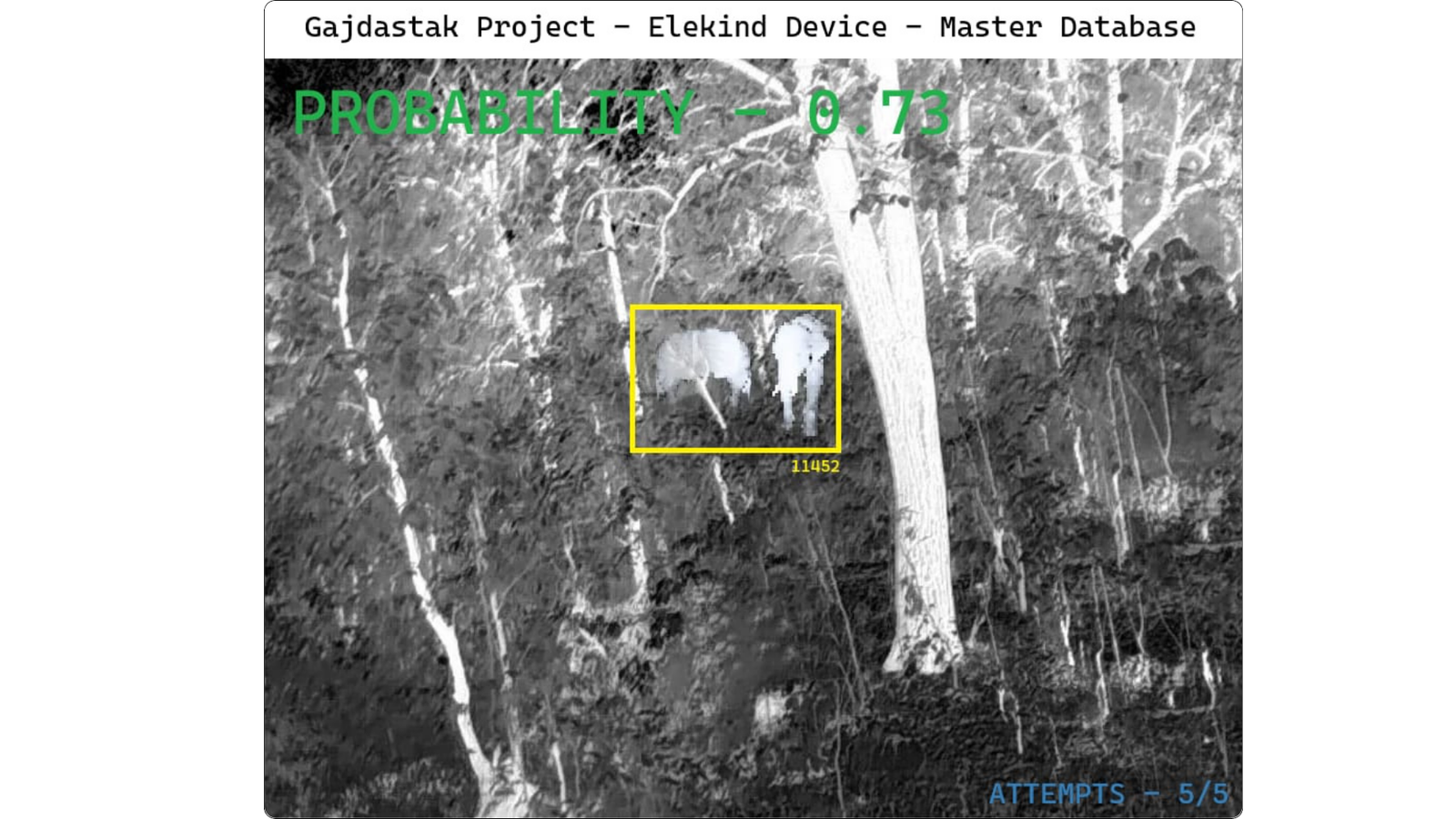
Actual GAJ-DASTAK thermal detection output — AI identifying elephant presence in complete darkness
Field Evidence from Chhattisgarh
GAJ-DASTAK has been field-validated across three forest divisions in Chhattisgarh: Katghora (Korba), Jashpur, and Raigarh. During the Bangursia deployment in Raigarh division, the system achieved zero crop loss during the entire deployment period. The deployment earned CAMPA approval and a government validation letter from the Divisional Forest Officer.
Traditional methods did not achieve this in the same locations. The difference was not effort or investment — it was approach. Early detection at distance, combined with unpredictable acoustic response, changes the dynamic of the encounter entirely. The elephant is deterred before it enters the conflict zone, and the deterrence remains effective because it does not repeat predictably.
Conclusion: Matching Intelligence with Intelligence
The failure of traditional elephant deterrence is not a failure of effort. Forest departments, communities, and conservation organizations have invested enormous resources into electric fences, firecrackers, trenches, and patrols. The failure is conceptual: these methods treat elephants as predictable obstacles, not as intelligent, adaptive, social animals that learn and remember.
The solution to intelligent conflict requires intelligent response. Not more fences. Not louder noise. Detection at distance. Adaptive deterrence. Technology that learns as fast as the animals it is designed to protect — and protect from.