How gaj dastak Empowers Communities to Protect
Here’s a rephrased version of your blog that keeps the same length and retains all keywords while improving flow and readability. The lush, green heartlands of Chhattisgarh, a quiet revolution in Community-Based Conservation, are taking shape. It is not merely about saving elephants—it is about redefining how humans and wildlife coexist. Leading this transformative movement is Gaj Dastak, an inspiring initiative that unites people, forests, and elephants under one shared mission: coexistence.
The Need for Community-based Conservation
India’s elephants, revered and majestic, face rising threats from habitat fragmentation, encroachment, and human-wildlife conflict. As shrinking forest corridors force herds closer to villages in their search for food, the outcomes can be disastrous—for both elephants and local communities.
While traditional conservation models have often focused on protecting wildlife from humans, Gaj Dastak turns that idea on its head—it protects animals with humans. Grounded in the philosophy of Community-Based Conservation, this initiative empowers local people to become active protectors of India’s elephants rather than passive observers.
What is Gaj Dastak?
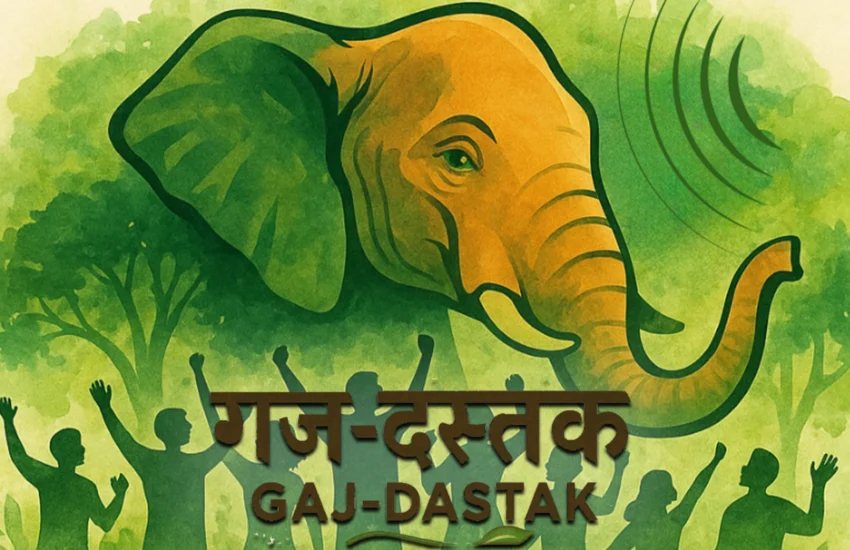
Gaj Dastak—meaning “the elephant’s knock”—is a dynamic awareness and action campaign spanning Chhattisgarh’s elephant habitats. Its mission is simple yet revolutionary: to ensure that when elephants “knock” at the doors of villages, the response they receive is empathy, preparedness, and respect—not panic.
Driven by collaboration among forest departments, NGOs, village communities, and schools, Gaj Dastak promotes lasting behavioural change and strengthens the foundation of human-wildlife coexistence.
Empowering Communities: The Core of Gaj Dastak
Community empowerment lies at the centre of Gaj Dastak. The initiative trains local volunteers, known as Gaj Mitras (“Friends of Elephants”), who serve as valuable bridges between the forest and the people. These volunteers undergo training on elephant behaviour, safety protocols, and conflict mitigation practices.
They alert villagers when elephant herds are nearby, provide guidance for safe forest movement, and spread awareness on how to reduce conflict. This network of vigilant, informed community members ensures early warning and proactive action—transforming moments of potential risk into opportunities for peaceful coexistence.
Education and Awareness: Changing Mindsets
Conservation begins with awareness, and Gaj Dastak invests deeply in this belief. Its outreach programs unite schoolchildren, farmers, and elders through storytelling, murals, puppet shows, and folk songs. These creative, culturally rooted methods demystify elephants and replace fear with understanding and compassion.
Through such educational engagement, people begin to perceive elephants not as intruders but as fellow inhabitants of the same land. This shift in perspective is key to fostering a lasting culture of human-wildlife coexistence.
Technology Meets Tradition
While indigenous wisdom drives the initiative, modern technology reinforces its impact. Gaj Dastak employs GPS-based tracking, mobile alert systems, and real-time mapping to monitor elephant movements. Villagers receive early warnings through SMS or loudspeakers, allowing them to safeguard crops and avoid direct encounters.
This fusion of tradition and innovation exemplifies the power of Community-Based Conservation—where people and technology unite in service of the planet’s shared future.
Impact on Indian Elephant Conservation
Since its inception, Gaj Dastak has reshaped the landscape of Indian Elephant Conservation across Chhattisgarh. The program has:
-
Reduced elephant-related casualties through early-warning systems.
-
Decreased crop losses and minimised retaliatory incidents.
-
Strengthened trust between forest officials and local communities.
-
Established a replicable model for other regions facing similar challenges.
By enabling communities to take ownership of conservation, Gaj Dastak proves that successful protection of wildlife is most effective when it is inclusive, localised, and cooperative.
A Vision for Coexistence
Gaj Dastak is more than a conservation program—it is a social movement grounded in compassion and collaboration. It envisions a future where elephants traverse their ancient corridors freely, and villagers live securely, aware of their role within a shared ecosystem.
The story of Chhattisgarh’s elephants reminds us that true conservation extends beyond preserving species—it nurtures harmony between humans and nature. Through Gaj Dastak, the people of Chhattisgarh showcase that coexistence is not just possible—it is powerful.
Conclusion
In the symphony of India’s forests, the footsteps of elephants have always resonated as a rhythm of life. Gaj Dastak ensures that this rhythm continues—not as a sound of fear or conflict, but as a harmonious call for unity.
By making local communities the guardians of the wild, the initiative stands as a shining model of Community-Based Conservation, where every “dastak” from the elephants is welcomed with awareness, compassion, and hope for a shared future.
